
Quick Summary: Hearing “Mashallah” is common in Muslim and multicultural conversations, but many people freeze up wondering how to reply. This guide breaks down what Mashallah actually means, why people say it, and offers respectful, natural reply ideas from simple English responses to proper Islamic phrases like JazakAllah Khair and Alhamdulillah so you always know what to say next.
If someone has just told you “Mashallah” after a compliment, good news, or an achievement and you’re not sure how to respond, you’re not alone. It’s one of the most common phrases in Muslim culture, yet many people, including Muslims themselves, aren’t always sure of the “correct” reply.
The good news: there isn’t just one right answer. Your response can be as simple as a smile and a “thank you,” or as meaningful as a heartfelt Islamic phrase. This guide walks through the meaning behind Mashallah, when it’s used, and dozens of reply ideas for every situation casual, religious, professional, or online.
Best Mashallah Reply Ideas for Social Media and Text Messages
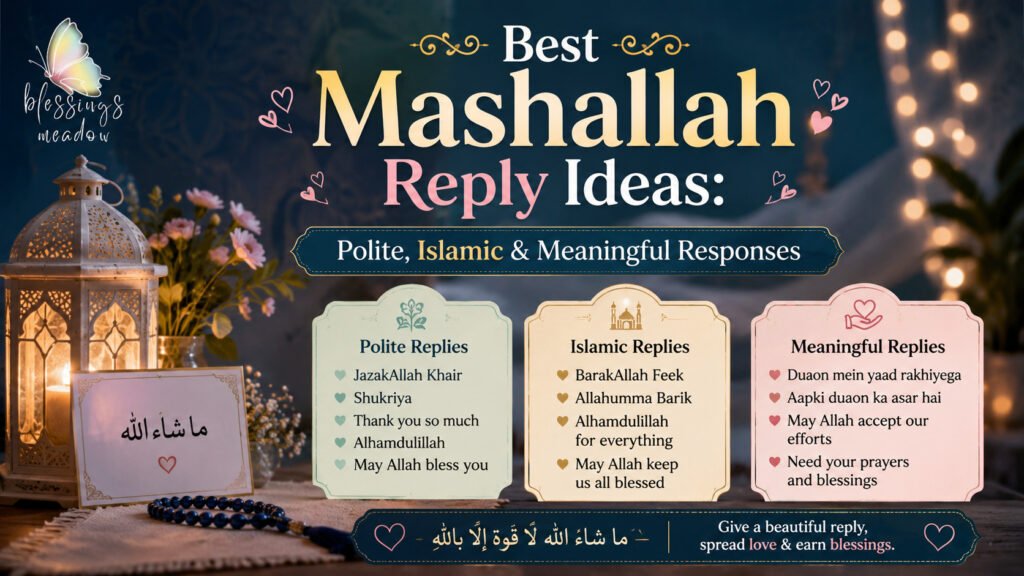
Mashallah Reply for Instagram Comments
- “Thank you so much, that means a lot 🙏”
- “Jazakallah Khair for your kind words!”
- “Thank you, Mashallah to you too!”
- “So sweet of you, thank you!”
- “Alhamdulillah, thank you for noticing 💛”
Masha Allah Reply for WhatsApp and Messenger
- “Jazakallah khair for the sweet message.”
- “Thank you so much, that made my day.”
- “Alhamdulillah, appreciate you saying that.”
- “Thank you, means a lot coming from you.”
- “Mashallah right back at you!”
Mashallah Ka Reply for Facebook and TikTok
- “Thank you so much for the kind comment!”
- “Jazakallah khair, appreciate it!”
- “Alhamdulillah, thank you!”
- “That’s so kind, thank you!”
- “Means a lot, thank you 🤍”
Short Reply to Mashallah for Texting
- “Thank you!”
- “Alhamdulillah 🙏”
- “Jazakallah khair!”
- “Appreciate it!”
- “Means a lot, thanks!”
Respectful English Replies to Mashallah
- “Thank you so much for saying that.”
- “That’s very kind of you, thank you.”
- “I really appreciate that, thank you.”
- “Thank you, that’s so thoughtful.”
- “Thanks so much, I’m grateful.”
Mashallah Reply Shukriya: Simple Thank-You Responses
Shukriya simply means “thank you” in Urdu and Hindi, making it a warm, culturally familiar way to respond without needing formal Arabic phrasing.
- “Shukriya, that’s very kind of you.”
- “Bohot shukriya for the sweet words.”
- “Shukriya, means a lot!”
- “Thank you, shukriya.”
- “Shukriya for noticing!”
Replies to Mashallah in Interfaith Conversations
In interfaith or mixed settings, a warm “thank you” is always appropriate and respectful you don’t need to use Arabic phrases you’re not familiar with to respond graciously.
- “Thank you, that’s so kind of you to say.”
- “I appreciate that, thank you.”
- “That means a lot, thank you.”
- “Thanks so much for the kind words.”
- “I really appreciate you saying that.”
When “Thank You” Is Enough as a Mashallah Reply
A plain, sincere “thank you” is never wrong. Not everyone is comfortable using Arabic religious phrases, and Muslims widely understand that a genuine thank-you is a perfectly respectful response.
How Americans and British Muslims Commonly Respond to Mashallah
Everyday Mashallah Reply Ideas Used in the U.S.
In everyday American Muslim conversations, replies tend to blend Islamic phrases with casual English a mix like “Alhamdulillah, thank you so much!” is extremely common and feels natural in daily life.
Common Mashallah Responses in the UK Muslim Community
Among British Muslims, replies often lean slightly more understated, such as a quiet “Jazakallah khair” or simply “cheers, that’s kind of you,” reflecting a blend of Islamic etiquette and everyday British conversational style.
Respectful Replies in Multicultural Conversations
- “Thank you, I appreciate that.”
- “Alhamdulillah, thanks for saying that.”
- “That’s really kind, thank you.”
- “Jazakallah khair!”
- “Thanks so much, means a lot.”
Mashallah Responses for Outstanding Players’ World Cup Performances
Mashallah is frequently used in sports commentary and fan conversations, especially when a Muslim athlete performs exceptionally well. A player or fan might reply with a humble acknowledgment rather than taking full credit for the achievement:
- “Alhamdulillah, grateful for the performance.”
- “Mashallah to the whole team, not just me.”
- “Thank you, all praise is due to Allah.”
- “Jazakallah khair for the support!”
- “Alhamdulillah, it was a team effort.”
This kind of response reflects a broader cultural habit: attributing success to blessing rather than personal boasting, even in high-pressure, high-visibility moments like international tournaments.
What Does Mashallah Mean?
Masha Allah Meaning Explained
Mashallah (ما شاء الله) is an Arabic phrase that translates roughly to “what Allah has willed” or “God has willed it.” It’s typically said to express admiration, appreciation, or amazement while acknowledging that the good thing being witnessed is a blessing from God.
Mashallah Meaning in English
In everyday English conversation, Mashallah functions similarly to saying “wow, that’s amazing” or “how wonderful,” but carries a spiritual layer it credits the beauty, success, or blessing to God rather than chance or pure human effort.
Spiritual and Cultural Meaning of Mashallah
Beyond translation, Mashallah carries a cultural weight of humility and gratitude. It’s a way of admiring something while simultaneously acknowledging that all good things ultimately come from God.
Why People Say Mashallah
People say Mashallah to express genuine admiration, to guard against envy or the “evil eye,” and to remind themselves and others that blessings beauty, success, health, or good fortune are gifts, not entitlements.
Origin and Religious Context of Mashallah
Arabic Roots of Mashallah
The phrase is built from three Arabic words: ma (what), sha’a (has willed), and Allah (God) together forming “what God has willed,” a phrase deeply rooted in Islamic theology and everyday Arabic speech.
Mashallah Reply in Islam: Religious Context and Etiquette
In Islamic teaching, saying Mashallah when admiring something is encouraged as a way to prevent envy from taking hold of the speaker or the listener. Responding graciously, whether with thanks or a similar phrase, is considered good manners (adab) in Islamic etiquette.
Quranic and Cultural Background
The phrase has roots connected to Quranic teaching about attributing blessings to God rather than solely to human effort, and it has become deeply embedded in everyday Muslim speech across cultures and languages.
Global Usage of Mashallah Beyond Muslims
Mashallah is widely used not just by Arabic speakers but across South Asian, Turkish, African, and broader Muslim communities worldwide and it’s increasingly recognized and used respectfully by non-Muslims in multicultural settings as well.
When Do People Say Mashallah? Common Situations
When Praising Something Good or Beautiful
Mashallah is commonly said when admiring something beautiful a home, an outfit, natural scenery, or even someone’s appearance as a way of appreciating it while crediting God.
When Celebrating Success or Achievement
It’s frequently used to celebrate accomplishments: graduations, promotions, business milestones, or personal achievements, expressing genuine happiness for someone’s success.
After Hearing Good News
When someone shares good news an engagement, a new job, good health results Mashallah is a natural, warm response that shares in their joy.
To Protect from Envy or the Evil Eye
Traditionally, saying Mashallah when admiring a child, a possession, or good fortune is believed to help ward off the “evil eye” (a concept found across many Middle Eastern and South Asian cultures), by acknowledging the blessing rather than admiring it with envy.
Why Is Mashallah Said? Understanding Its Deeper Meaning
Gratitude and Acknowledgment of Blessings
At its core, Mashallah reflects gratitude a recognition that good things are blessings rather than something owed or guaranteed.
Protection from Jealousy and the Evil Eye
Saying it is also a spiritual safeguard, a way of admiring without envy, and protecting both speaker and listener from negative energy tied to jealousy.
Humility and Expression of Faith
It reflects humility redirecting praise toward God rather than pure self-credit, even during personal achievements.
Social and Cultural Importance
Socially, it functions as a warm, culturally understood way of expressing admiration that carries more depth than a simple compliment.
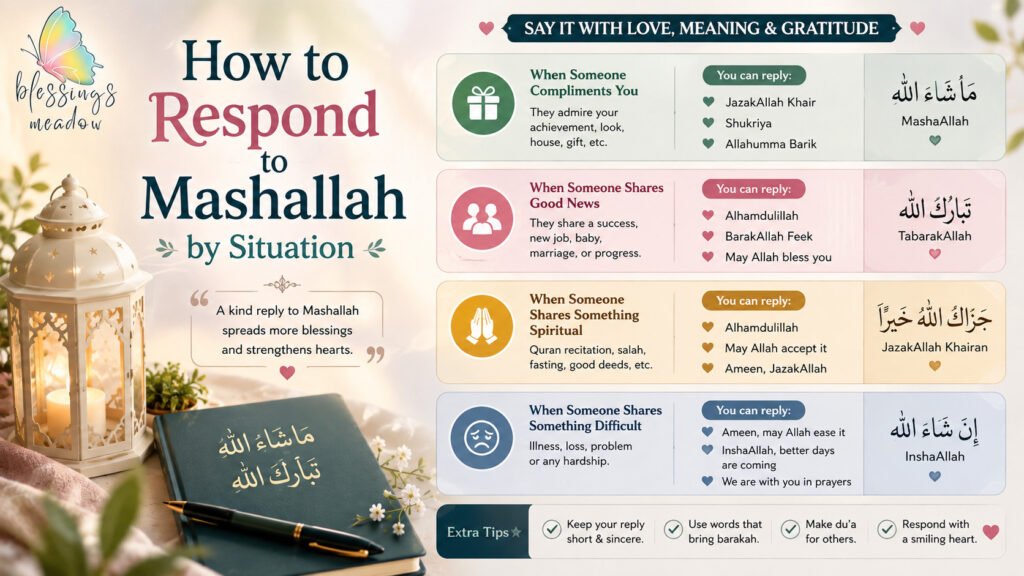
How to Respond to Mashallah by Situation
Simple and Common Mashallah Reply
- “Thank you!”
- “Alhamdulillah.”
- “Jazakallah khair.”
- “Thanks so much!”
- “Appreciate it!”
Polite and Respectful Reply to Mashallah
- “Thank you, that’s very kind.”
- “I appreciate you saying that.”
- “Jazakallah khair for the kind words.”
- “Thank you so much, truly.”
- “That means a lot, thank you.”
Religious and Islamic Mashallah Replies
- “Alhamdulillah (all praise is due to Allah).”
- “Jazakallah khair (may Allah reward you with goodness).”
- “Subhanallah (glory be to God).”
- “Barakallahu feek (may Allah bless you).”
- “Ameen, thank you for the dua.”
Casual and Friendly Responses
- “Aw, thank you!”
- “That’s so sweet, thanks!”
- “Appreciate you!”
- “Thanks a lot!”
- “That made my day, thank you!”
Humble and Modest Responses
- “Thank you, it’s a blessing really.”
- “Alhamdulillah, I’m just grateful.”
- “Thank you, I don’t take it for granted.”
- “It’s all a blessing, thank you.”
- “Thank you, Alhamdulillah for everything.”
Mashallah Reply Jazakallah: When and How to Use It
JazakAllah khair means “may Allah reward you with goodness,” making it an especially meaningful reply when someone’s Mashallah comes with a genuine compliment or well-wish it turns their kind words back into a prayer for them.
Mashallah Reply Shukriya: When a Thank-You Is Appropriate
Shukriya works well in casual, everyday exchanges especially in South Asian communities when a simple, warm thank-you fits better than a formal religious phrase.
Reply of Mashallah in Arabic: Natural Arabic Responses
- “Jazakallah khair” (may God reward you with good)
- “Barakallahu feek” (may God bless you)
- “Shukran” (thank you)
- “Alhamdulillah” (all praise is due to God)
- “Ameen” (in response to a well-wish or dua)
25 Quick One-Line Mashallah Replies That Always Work
Short Mashallah Reply Ideas for Everyday Conversations
- Thank you!
- Alhamdulillah.
- Jazakallah khair.
- Appreciate it!
- Thanks so much.
- That’s so kind of you.
- Means a lot, thank you.
- Barakallahu feek.
- Shukran!
- Thank you, truly.
- Aw, thanks!
- Grateful for that.
- That made my day.
- Thanks a ton!
- Shukriya!
- Ameen, thank you.
- Thank you, Alhamdulillah.
- Appreciate you saying that.
- Thanks, that’s sweet of you.
- Jazakallah khair for the kind words.
- Thank you so much!
- Really appreciate it.
- Thanks, means the world.
- Barakallah!
- Thank you kindly.
Situational Responses to Mashallah
When Someone Compliments Your Looks
- “Thank you, that’s very kind.”
- “Alhamdulillah, appreciate it.”
- “Jazakallah khair.”
- “Thanks so much!”
- “That’s sweet, thank you.”
When Praised for Success or Achievement
- “Alhamdulillah, it wasn’t easy but grateful for it.”
- “Thank you, I appreciate the support.”
- “Jazakallah khair for the kind words.”
- “Thanks, means a lot after all the hard work.”
- “Alhamdulillah, truly grateful.”
When Receiving Blessings or Good News
- “Alhamdulillah, thank you for sharing in the joy!”
- “Thank you so much, we’re so grateful.”
- “Jazakallah khair for the dua.”
- “Ameen, thank you!”
- “Alhamdulillah, appreciate the kind words.”
How to Reply to Mashallah Tabarakallah
Tabarakallah means “blessed is God,” often paired with Mashallah for extra emphasis. A fitting reply is a similar phrase of gratitude:
- “Ameen, jazakallah khair.”
- “Alhamdulillah, thank you.”
- “Barakallahu feek.”
- “Thank you so much, truly grateful.”
- “Ameen, appreciate the dua.”
How to Respond to Mashallah Reddit Discussions and Online Comments
In online spaces like Reddit, where users may come from diverse backgrounds, a simple and genuine reply works best no need to overthink it:
- “Thanks so much, appreciate the kind words!”
- “Alhamdulillah, thank you!”
- “That’s really kind, thank you.”
- “Jazakallah khair!”
- “Appreciate you saying that.”
Alhamdulillah vs Mashallah vs Inshallah: What Is the Difference?
| Phrase | Meaning | Common Use |
| Mashallah | “What God has willed” | Expressing admiration or praise for something good |
| Alhamdulillah | “All praise is due to God” | Expressing gratitude, often after good news or blessings |
| Inshallah | “God willing” | Expressing hope or intention for something in the future |
Alhamdulillah Reply in Arabic and When to Use It
Alhamdulillah is typically said by the person receiving good news or a blessing, rather than as a direct “reply” to someone else though it can be used in response to Mashallah as a way of agreeing with the sentiment of gratitude.
When Alhamdulillah Is an Appropriate Reply to Mashallah
If someone says Mashallah in response to your good news or achievement, replying with “Alhamdulillah” is entirely appropriate it echoes their acknowledgment of blessing with your own gratitude.
Mashallah, Inshallah and Alhamdulillah Compared
Though often grouped together, these three phrases serve different purposes: Mashallah praises something present, Alhamdulillah expresses gratitude, and Inshallah expresses hope for the future understanding the distinction helps you use and respond to each correctly.
Common Mistakes When Responding to Mashallah
Ignoring the Phrase
Simply not responding can come across as dismissive, even if unintentional a brief acknowledgment, even just “thank you,” is always appreciated.
Using an Inappropriate Tone
Responding sarcastically or dismissively to a sincere Mashallah can feel disrespectful, especially in religious or family settings.
Misunderstanding the Meaning
Some assume Mashallah is purely a compliment with no religious weight, which can lead to responses that feel out of place in more traditional or religious contexts.
Using Irrelevant or Forced Replies
Forcing an Arabic phrase you’re unfamiliar with can feel awkward a genuine “thank you” is always better than a mispronounced or misunderstood religious phrase.
Cultural Etiquette Around Mashallah
Respect for Islamic Culture and Traditions
Understanding the religious and cultural roots of Mashallah helps ensure your response feels respectful rather than performative.
Proper Mashallah Response Manners
A warm tone, genuine acknowledgment, and brief response are generally considered good etiquette across most Muslim cultures.
Tone, Sincerity and Humility
Sincerity matters more than the specific words chosen a heartfelt “thank you” will always be better received than a phrase said without genuine warmth.
Social Expectations When Responding
In many Muslim communities, some response even brief is culturally expected, as silence can unintentionally feel like the compliment or blessing was ignored.
Real-Life Mashallah Conversation Examples
Family Conversation Examples
Aunt: “Mashallah, you’ve grown so much!” Reply: “Alhamdulillah, thank you for noticing!”
Social Interaction Examples
Friend: “Mashallah, your new home is beautiful!” Reply: “Thank you so much, means a lot coming from you.”
Professional Setting Examples
Colleague: “Mashallah, great presentation today.” Reply: “Thank you, I really appreciate that.”
Online, Reddit and Chat Examples
Comment: “Mashallah, congratulations on the new job!” Reply: “Jazakallah khair, appreciate the support!”
Advanced Tips to Respond to Mashallah Naturally and Confidently
Matching Your Reply to the Tone and Context
A formal setting calls for a slightly more composed reply, while casual conversations with friends allow for warmer, more relaxed responses.
Using Appropriate Religious Phrases
If you’re comfortable with Islamic phrases, using them appropriately JazakAllah khair, Alhamdulillah, Barakallahu feek adds depth and sincerity to your response.
Choosing Between Arabic and English Responses
There’s no rule requiring an Arabic response English replies like “thank you so much” are equally respectful, especially outside religious or cultural settings.
Keeping Your Response Simple and Sincere
Overcomplicating your reply isn’t necessary. A short, genuine acknowledgment almost always lands better than an elaborate one.
Building Confidence in Cross-Cultural Communication
The more familiar you become with phrases like Mashallah, the more naturally you’ll be able to respond confidence comes with understanding, not memorization.
Tips to Respond to Mashallah Gracefully
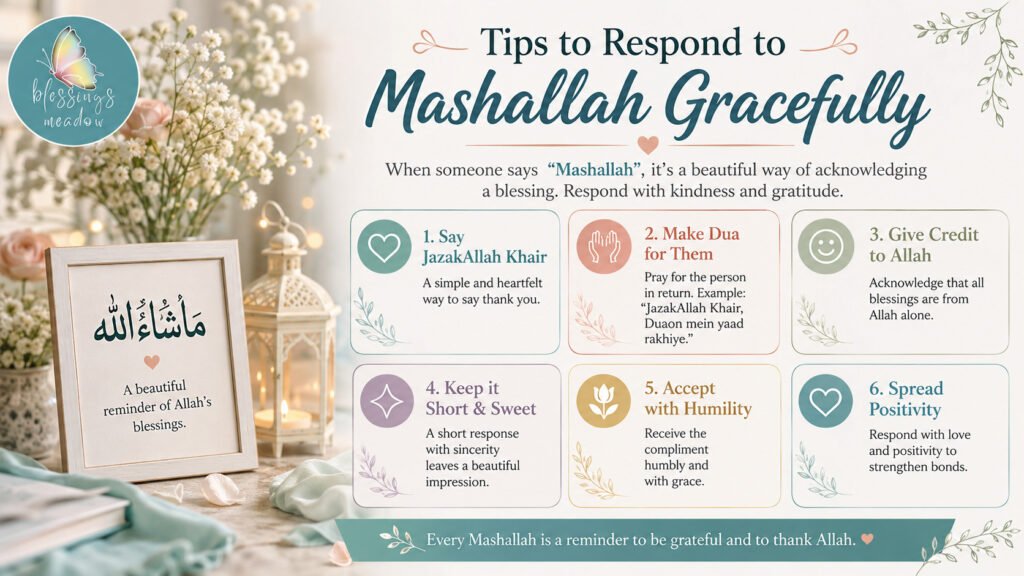
Keep Humility in Your Reply
Avoid responses that sound boastful humility fits the spirit of the phrase itself.
Show Gratitude and Respect
A grateful tone, even in a short reply, honors the sentiment behind Mashallah.
Match Your Response to the Situation
Casual compliments call for casual replies; deeper blessings or achievements may call for a more heartfelt response.
Choose a Natural Mashallah Reply
Pick a reply that feels authentic to you whether that’s a simple “thank you” or a fuller Islamic phrase rather than forcing something unfamiliar.
Frequently Asked Questions About Mashallah Replies
What Is the Best Mashallah Reply?
A sincere “thank you” or “Alhamdulillah” is always appropriate and works well in nearly any situation.
What Is the Best Masha Allah Reply in Arabic?
“Jazakallah khair” (may Allah reward you with goodness) is one of the most commonly used and well-received Arabic replies.
Should Non-Muslims Respond to Mashallah?
Yes a simple “thank you” is a perfectly respectful and appropriate response, regardless of religious background.
Is It Rude Not to Respond to Mashallah?
It’s generally considered polite to acknowledge it, even briefly, though it’s not meant to cause offense if missed occasionally.
Can You Say Mashallah Back to Someone?
Yes, saying “Mashallah” back is acceptable, especially if you’re admiring something about them in return.
What Does It Mean If Someone Says Mashallah to Me?
It typically means they’re expressing genuine admiration or happiness for you while acknowledging it as a blessing from God.
Is JazakAllah Khair a Good Reply to Mashallah?
Yes, it’s a warm and appropriate response, especially when the Mashallah comes with a kind compliment or well-wish.
Is Shukriya a Good Mashallah Reply?
Yes, “shukriya” is a simple, culturally familiar way to say thank you, especially in South Asian Muslim communities.
Can I Use Alhamdulillah as a Response to Mashallah?
Yes, especially when the Mashallah relates to your own good news or blessing it reflects shared gratitude.
What Is the Difference Between Mashallah and Inshallah?
Mashallah praises something that has already happened, while Inshallah expresses hope for something in the future.
How Do You Reply to Mashallah Tabarakallah?
A simple “Ameen, jazakallah khair” or “Alhamdulillah, thank you” works well as a respectful reply.
Conclusion: Choosing the Right Mashallah Reply
There’s no single “correct” way to respond to Mashallah what matters most is sincerity. Whether you choose a simple “thank you,” a warm “Alhamdulillah,” or a heartfelt “Jazakallah khair,” your response is really just an extension of gratitude and respect.
The next time someone says Mashallah to you, you won’t need to pause and wonder what to say. Pick the reply that feels most natural to you, say it with warmth, and let the moment speak for itself.
Related reading you might enjoy:

